Rules
California Death Certificate Facts for Archive Research
California death certificate facts for archive research: copy types, restricted fields, the 50-year rule, and where related records may appear.
What to take away
- California death certificate facts begin with two different documents: a certified copy for authorized requesters and an informational copy stamped for anyone else; the public can request the informational version.
- Certain fields are restricted on the informational copy, including the Social Security number and the medical certification of cause of death.
- California law makes death records confidential for 50 years from the date of death, then the county or state may release them more freely.
- Cause of death is not automatically public. A coroner or medical examiner may release a summary, but the certificate itself is not the usual route.
- The California Department of Public Health Vital Records office handles state applications; the county recorder in the county of death is another ordering route.
The two documents California actually issues
California splits its death records into an authorized copy and an informational copy. The authorized copy goes to a person who can show a relationship to the deceased or a legal need. Anyone can request the informational copy, which carries a visible stamp saying it cannot be used for identity or legal purposes.
Authorized vs Informational Copy
Authorized copy
- Who can get it
- Relationship or legal need
- Visible stamp
- Absent
- Legal use
- Allowed
- Where to order
- State office or county
Informational copy
- Who can get it
- Anyone who pays fee
- Visible stamp
- Present
- Legal use
- Not allowed
- Where to order
- State office or county
That distinction matters for anyone reading about a public figure. The document that circulates online is almost always the informational copy. It is a real state record, not a leak, and it omits the parts California treats as private.
Ordering runs through the state office or the county recorder where the death was registered. The CDC's Where to Write for Vital Records directory links to California's vital records office and county contacts. Check with the office holding the record for current application instructions.
What the informational copy leaves out
The restricted fields are the point of the two-tier system. California removes the Social Security number from the informational copy, along with the medical certification section. The medical certification is where a physician or coroner records the immediate cause, the underlying cause and any contributing conditions.
Fields Shown or Withheld
Authorized copy
- Name, date, place
- Shown
- Age, sex, race
- Shown
- Social Security number
- Shown
- Cause of death
- Shown
- Certifier name
- Shown
- Informational stamp
- Absent
Informational copy
- Name, date, place
- Shown
- Age, sex, race
- Shown
- Social Security number
- Withheld
- Cause of death
- Withheld
- Certifier name
- Withheld
- Informational stamp
- Present
Authorized copy
- Name, date and place of death
- Shown
- Age, sex, race, marital status
- Shown
- Social Security number
- Shown
- Cause of death, medical certification
- Shown
- Certifier name and signature
- Shown
- Informational stamp
- Absent
Informational copy
- Name, date and place of death
- Shown
- Age, sex, race, marital status
- Shown
- Social Security number
- Withheld
- Cause of death, medical certification
- Withheld
- Certifier name and signature
- Withheld
- Informational stamp
- Present
A reader who wants the cause of death will not get it from the informational certificate. The field is simply blank or marked confidential. This is the single most common misunderstanding about public death records California releases.
The 50 year rule and what it changes
California treats death records as confidential for 50 years after the date of death under California Health and Safety Code § 103526. After that period, the record can be released without the same proof of relationship, and researchers can request it more like an ordinary public document.
The rule explains why older celebrity records are easier to obtain than recent ones. A death from the 1940s is generally open. A death from five years ago is not, no matter how famous the person was.
Fame does not create an exception. California has no public figure carve-out in its vital records statutes. A governor and a neighbor are handled under the same rule.
Where cause of death does become public
When a death falls under coroner or medical examiner jurisdiction, that office may release a summary or confirm a cause after next of kin are notified. This is a separate channel from the certificate, and it is why news outlets can report a cause while the certificate stays restricted.
A coroner may also hold an inquest, which produces testimony and findings that can become part of the court file. Those files follow court access rules rather than vital records rules.
For anyone tracking how these details are recorded across many cases, the cause of death guides explain the difference between a certificate field and a coroner finding. The two are not interchangeable, and reporters sometimes blur them.
Reading the record as a document
A death certificate is a form completed under time pressure, often by someone who did not know the deceased well. Informant details, occupation and parents' names can be wrong. Treat the certificate as one source, not the final word.
Cross-check the death certificate against probate filings, which are court records and usually open. The probate and estate filings trail is often more revealing about a public figure than the certificate itself.
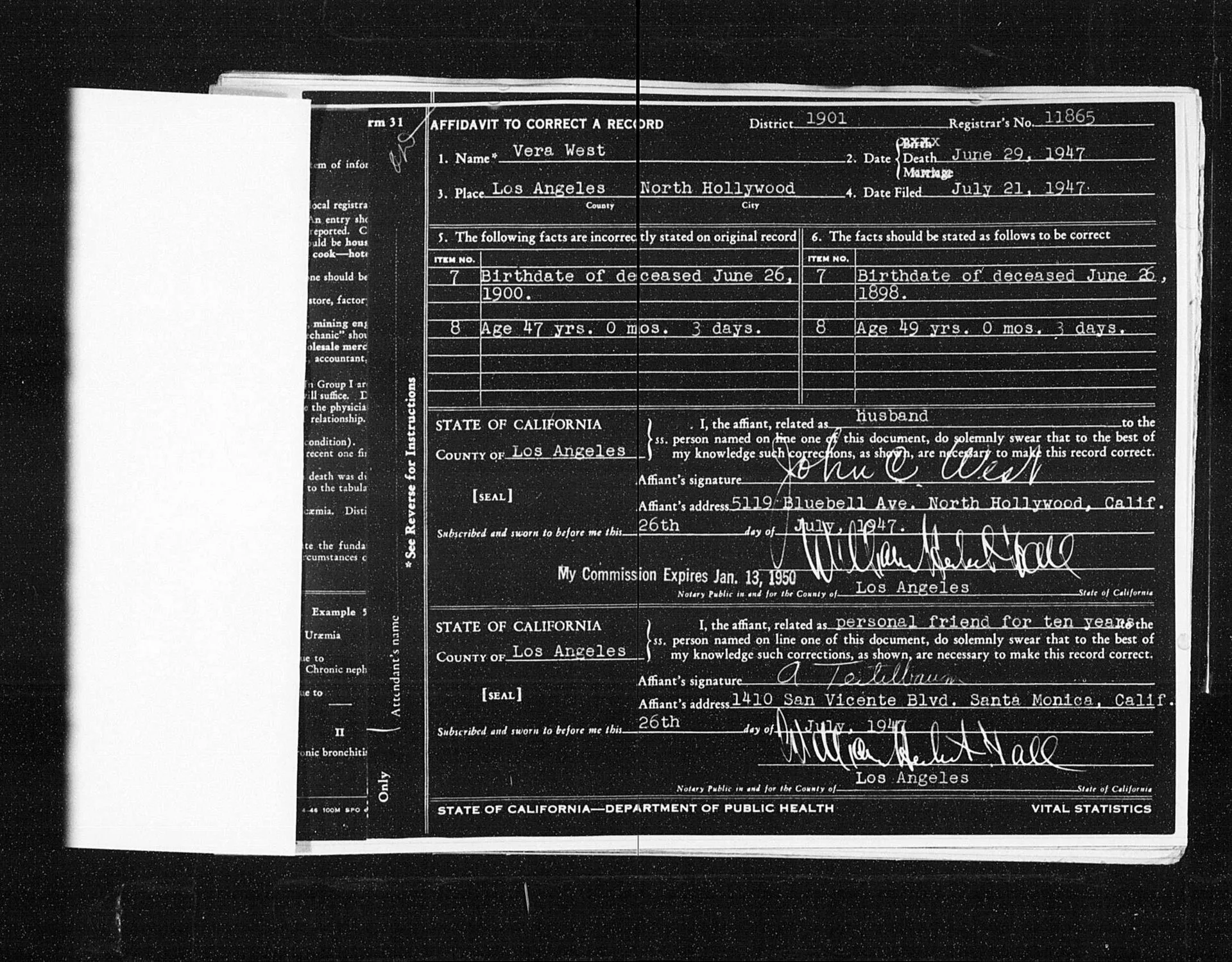
If a record contains an error, California has a correction process. Contact the California Department of Public Health Vital Records office for the state's amendment requirements. USA.gov's state-specific guidance on correcting government records can help locate the appropriate state office.
How to order a copy
- Confirm the county where the death was registered, since the state and county hold separate indexes.
- Decide whether you qualify for an authorized copy or must accept the informational version.
- Complete the California Application for Certified Copy of Death Record (Form VS 112) and submit it according to the current instructions.
- Submit acceptable photo identification with the request.
- Check current processing estimates with the state or county office before submitting; timing varies with backlog.
The CDC's Where to Write for Vital Records directory links to the California office and county recorders. Confirm current application requirements and processing estimates with the office holding the record.
- Confirm the date and county of death before applying.
- Check whether you qualify for an authorized copy.
- Keep a copy of the application and payment receipt.
- Verify the spelling of names against another source.
A certificate that omits cause of death is still an official record. The missing field is the law working as written, not a redaction error.