
Rules
Deaths Today: How to Make a Celebrity Death Source Note Recheckable
Deaths today: a source-note format for celebrity death entries, with details that help readers trace an announcement after a link changes or fails.
A deaths-today entry should give readers more than a clickable URL. This guide shows how to make a source note for a celebrity death entry that identifies what the source says, where it appeared, and how to find it again if a link changes or fails. It also explains what a link can support—and what it cannot—so a memorial archive does not make a source appear stronger than it is.
Give the source note one clear job
A source note should let a reader identify the material behind a particular statement in an entry. It is not a substitute for that material, and it should not imply that a source supports details it never mentions. The first task is to match the note to the exact claim: an announcement of a death, a service detail, a biographical fact, or a cause of death are different claims and may need different support.
For example, a family statement can be cited as the family's announcement. A funeral-home notice can support the service information it publishes. A news obituary can be cited for what that article reports, while the sources it names may offer a more direct route to particular facts. Avoid turning one kind of evidence into proof of every detail in an entry.
This distinction is useful on a daily record page, where brief entries can make a link seem to support more than it does. Name the claim the source supports in the note, and keep any unresolved detail out of the entry or clearly mark it as unconfirmed.
Naming the channel helps. A celebrity death usually reaches the public through one of a few routes: wire copy from The Associated Press or Reuters, a news obituary written by an obituaries desk, a notice published by a funeral home, or a statement from the family. When the actor Chadwick Boseman’s family announced his death in a statement posted to his social media accounts, that statement — not the news stories that quoted it — was the source for the fact that the family had announced the death.
Choose a link that leads to the material
Prefer a link to the original announcement or publication, rather than a later list that repeats the claim. If the source is not online, give a reference specific enough to help someone locate it. Another compilation may help a reader find a lead, but it does not replace the underlying source.
Most celebrity death notes point to one of a handful of page types, and each supports only what it publishes: wire copy from The Associated Press, a news obituary from The New York Times or the BBC, a notice on Legacy.com, or a memorial entry on Find a Grave. Link the specific article, notice, or memorial page — never the outlet’s home page, its search results, or a fan account that reposts the item.
| Link or reference | What it can support | What to avoid implying |
|---|---|---|
| Family statement | That the family made the announcement and the details it includes | That it confirms details the statement does not give |
| Funeral-home notice | The information stated in that notice | That every biographical detail or cause of death has been independently verified |
| News obituary | What the article reports | That every reported detail comes from a named primary source |
| Newspaper reference | The article or notice identified by its publication details | That a search result alone is the article itself |
| Another compilation | That the other page repeats a claim | That the repeated claim has been traced to its original source |
Source link vs. not a source
Counts as a source
- Family statement
- Yes
- Funeral notice
- Yes
- Institution announcement
- Yes
- Civil register entry
- Yes
- Another compilation
- No
- News naming its source
- Acceptable
Does not count
- Family statement
- No
- Funeral notice
- No
- Institution announcement
- No
- Civil register entry
- No
- Another compilation
- Yes
- News naming its source
- Link the source
When the trail involves newspaper research, the Library of Congress has a guide titled Chronicling America search tips. Use a search guide to help locate material; cite the newspaper item or notice you actually relied on, not the guide as proof of a particular death.
Beyond Chronicling America, the same era of newspapers is indexed in commercial and library collections, among them Newspapers.com, ProQuest Historical Newspapers, and the Gale newspaper archives. Record which collection you searched along with the headline, paper, and page, so a later reader can repeat the search in the same place.
A link should also lead as directly as practical to the relevant item. A publisher's home page or a broad search page can be a starting point, but it leaves the reader to repeat the search. If a direct page is available, link to it and record enough information to identify it without relying on the URL alone.
Record enough detail to find it again
A useful source note answers a few practical questions: who issued or published the material, what it was called, when it appeared, where it can be found, and when the archive checked it. Include only details that apply and can be verified. Do not fill gaps with an assumed date, author, title, or source.
A compact format can look like this:
Source: [publisher or issuing body], “ [exact title or heading] ,” [publication date], [direct link or reference]. Checked [date]. Supports: [the specific claim used in the entry].
The bracketed text is a template, not a citation to a real death. Replace each field with information from the source. If the page has no byline or formal headline, identify it by the heading or other wording actually shown rather than inventing one.
For a source that is not online, describe the publication or issuing body and the available identifying details. For a newspaper item, that may include the newspaper name, item title or heading, publication date, and page if known. For an institutional statement, identify the institution and the date of the statement. A reference should be precise enough to distinguish the item from other material by the same publisher.
Use a separate checked date to show when the archive last opened or consulted the source. That is not necessarily the date the source was published. Keeping the two distinct helps a later reader understand whether a link was recently reviewed without changing the date of the original announcement.
Filled in for real sources, the fields look like this:
Source: Statement from the family of the actor Chadwick Boseman, posted to his verified social media accounts; snapshot at the Wayback Machine. Checked [date you opened the snapshot]. Supports: that the family announced the death.
Source: Centers for Disease Control and Prevention, National Vital Statistics System, “NVSS — Mortality Data,” cdc.gov; snapshot at archive.today. Checked [date]. Supports: that the national system records deaths from every county in the United States.
The first note sends a reader to a social-media statement that later news stories quoted; the archived copy, not the quoting story, is what it cites. The second records a government page that can be re-checked at any time. Neither note claims more than its source says.
Record beside every link
- Publishing body
- Title or heading
- Date of publication
- Date the desk consulted it
- Archived copy if link dies
- Mark if source no longer available
Handle a changed or unavailable link honestly
A page can move, be revised, or stop being available at its original address. That does not by itself establish whether the underlying statement was accurate; it means the link no longer leads the reader to the same material. The note’s publisher, title, date, and other identifying details can help someone look for the item in the publisher’s own archive, through a newspaper collection, or in a web archive that keeps copies of dead pages — the Internet Archive’s Wayback Machine, archive.today, and Perma.cc are the services most often used for that job. Save the snapshot’s URL beside the original link, and say which service holds the copy.
If the source cannot be found again, say that the link is unavailable and whether the archive could recheck the claim. Do not present an untraceable link as if it still lets readers inspect the evidence. If the note no longer supports the entry, the entry should not imply that it does.
If an entry changes after publication, preserve a visible account of the change instead of silently removing the earlier sourcing context. The archive’s dated correction is the place for a reader to follow a documented change. This article’s focus is narrower: making the original source note useful enough to revisit.
Cite the source, not just the archive entry
An archive entry is a useful route to a source, but it is still the archive’s account of the material. When citing a specific fact, cite the source that supports that fact whenever it is available. If you also cite the archive, identify the entry and the version or correction you consulted; do not make the archive citation stand in for a source it merely links to.
Keep the source note attached to the claim it supports. A notice may confirm that an announcement was published without supporting an additional claim about circumstances. A news obituary may include several facts with different sourcing. Cite or describe those limits rather than allowing the presence of one link to lend authority to every sentence around it.
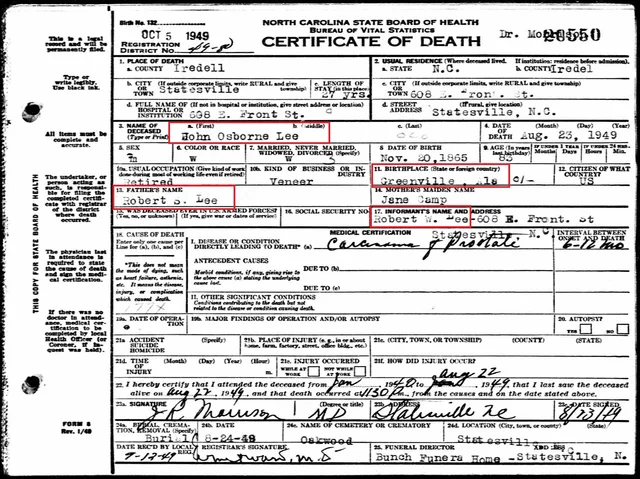
For the death itself, the primary records sit with state and local offices rather than with the federal government. The National Vital Statistics System captures information about death from all causes from every county in the United States — about 2.8 million deaths each year — to produce timely and accurate mortality data. A state or county vital records office issues the certificate, and a coroner or medical examiner holds the file for a death that falls under its jurisdiction; the CDC’s Where to Write for Vital Records page points to the issuing office for each state and notes that the federal government does not distribute certificates, files, or indexes with identifying information for vital records.
For older records, the archive’s Anniversaries and Archives page discusses archival material and citations more broadly. For a daily celebrity-death entry, the working rule is straightforward: identify the source, state exactly what it supports, and leave a trail another reader can follow.
Quick checks before publishing
Before an entry goes live, check that the note answers these questions:
- Does the link lead to the announcement or report used, rather than only to another compilation?
- Does the note identify the publisher or issuer and the title or heading as shown?
- Are the publication date and the archive’s checked date kept distinct?
- Is the claim in the entry no broader than what the source says?
- If a direct link is unavailable, does the reference still help a reader locate the material?
- If the source cannot be recovered, does the entry say so rather than treating the old link as current evidence?
Two of those checks need a standard. “Direct enough” means a reader who opens the link lands on the item itself — the statement, notice, article, or record — without running the search again. “No broader than the source” means the sentence in the entry would still be true if the link were dropped and only the note’s description of the source were left.
A complete source note does not guarantee that every claim is true. It gives readers a fair way to inspect the material, see what it supports, and understand what remains uncertain.